Many year ago, hubby and I visited the Eastern State Penitentiary in Philadelphia. The prison started out as a great idea for the Quakers assumed people were inherently good. Therefore, the penitentiary was built so that those incarcerated would have time to reflect on the bad things they did and return to good behavior.
Each inmate had a private cell. The only book with each prisoner was a Bible. They did not talk to anyone. They each had a private yard to walk in for exercise.
It was, in truth, solitary confinement. Evidently, a lot of inmates went crazy and the system changed.
Al Capone stayed there briefly. He had a rather nicely appointed cell--with a radio, lamp, rug, armchair, and desk.
We were told that the prison holds reunions every year.
The audio tour is great and part of the price of admission. It is an interesting place to see. I hear they have some awesome Halloween tours. :^)
Today I would like to introduce you to Rachel James. She grew fascinated with the medieval time period as a child. Dubbed a bookworm from a young age, Rachel found herself surrounded by places steeped in history and adventure. She enjoyed trips with her family to visit nearby derelict castles and Roman ruins, and that coupled with a zealous imagination and love for stories, sparked her interest in knights, fortresses and ancient kingdoms.
Born and bred in England, Rachel writes adventure driven historical romance, she is also a pastor’s wife, and has three beautiful little princesses. She minored in creative writing at university and strives to entertain, inspire and encourage others in their own spiritual journey. She’s also captivated by romantic tales… combine it with a little history and a hot cup of tea, and she’s smitten! Find her at www.rachelajames.com
Rachel has written an Inspirational Medieval Romance, The Forgotten Princess of Elmetia.
The story is set in 616AD, when one fatal night the ancient Kingdom of Elmetia falls. Saxons kill the Elmetian King, and capture Princess Teagen. Teagen poses as a slave girl and works for the Saxons in the Kingdom of Deira, until she discovers her brother is alive. She finds a way to escape, and her path crosses with Ryce the Warrior.
Struggling with his past, and angry against the tyrant Saxon king, Ryce helps the princess in pursuit of her brother. But just as the connection between them intensifies, obstacles get in their way. The Saxon king now wants vengeance, and will stop at nothing to get it.
Excerpt
616 AD, The Kingdom of Elmetia
Teagen scrambled under the table as the first fire-drenched arrow shot through the sky. Within seconds, thatched rooftops blazed and smoke bellowed throughout the palace. Frantic screams replaced the joyful music playing moments before.
“Princess,” Teagen’s nurse hissed from behind a wooden bench. “Are ye injured?”
“Nay.” She cast a wary glance as the battle unfolded before her. “What’s happening? Is it Saxons?”
Her nurse stretched her arm over and stroked her hair. “Aye, princess. Seems to be. Now stay put here while I find yer brother.”
Teagen flinched. “Don’t leave me Dera, please—Niall will be with Papa, they’ll be safe.”
Dera’s face paled. “I hope not, lassie, for yer brother’s sake, I pray he’s not.”
What could she mean? Was Papa in trouble?
She jumped out from her hiding place. “Then I’ll come with ye—”
Dera pushed her down firmly. “Nay, ‘tis not safe. Whatever ye do, do not let them capture ye, understand?”
She nodded, dumbfounded as Dera disappeared.
Grabbing the bottom of her long silk dress, she covered her face in an attempt to subdue the nausea that welled within. She wouldn’t look. She couldn’t. Where was Papa? She needed him right now, to hold her, and keep her safe.
“Teagen.”
A wave of relief washed over her. “Papa!” Teagen ran toward him, tears threatening her eyes.
“Shhh, lassie.” Her father scooped her up and headed for the kitchen just off the Great Hall. He opened a small stone cupboard and placed her inside.
“Stay in here, do ye understand? Do not come out until yer brother gets ye.”
“Please don’t leave me, Papa. Everyone keeps leaving me.” She tasted the salty tears that streamed her face.
Her father stroked her cheek. “Oh, lassie, I love ye so much. Ye know this, don’t ye?”
She nodded.
“Now be a brave girl and stay put.”
She gave her father a lingering hug and breathed in his comforting musky scent, her eyes averting his blood stained tunic. As he shut the cupboard door, the sound of the latch closing sent shivers through her body. The darkness did not mask the coldness of the damp stone walls, or the stale air which stifled her breathing. A sob lodged in her throat. I need to be brave for Papa.
Muffled sounds from outside grew louder—the clash of iron on iron, the collapse of buildings, and cries for help.
“King Ceretic is dead!”
Teagen stopped breathing. It could not be true.
“And what of the rest of the family?”
“Not yet found.”
“We do not leave until they are dead. Burn everything, and gather the survivors—we’ll take them to the slave market.”
She squeezed her eyes together, shutting out the fuzzy sensation that threatened to overtake her. Please, God. Nay. There surely must be some mistake.
Teagen could wait no longer. Despite her father’s strict instructions, she pushed open the door and fell on the kitchen floor. She gasped in a huge breath of air and scrambled to the doorway. Soldiers littered the outside, and in the centre, stood the Saxon King—Edwin the Tyrant. Her stomach lurched as she saw the remains of her father’s body.
Oh, Heavenly Father. She collapsed to the ground. If her father was dead, it meant her brother Niall would likely be too. She studied the hem of her fine tunic and caressed the intricate beading Dera had sewn on the day before.
She stiffened. If they discovered her true identity as the king’s daughter, she too would be slain. She had to get out of these clothes. Her eyes rested on the dead bodies piled up outside the kitchen entrance and her heart broke as she spotted one of her friends lying on the ground. She kept low, reached out and pulled her friend further inside the kitchen.
“I’m sorry, Hilda,” she whispered to the girl, “but I’m going to need yer clothes. Ye won’t have use for them anymore.” She closed the girl’s eyelids, said a quick prayer, and removed the simple tunic and redressed her young friend in her own grand attire.
She ran out of the kitchen and toward the oak tree at the top of the hill, knowing she would be seen. She perched under a sloping branch and gazed out—her entire world ablaze. Soldiers rummaged through the dead bodies looking for valuables to keep for themselves. Teagen covered her ears as cries penetrated the night. Curling herself into a ball, she cradled her arms around her knees and rocked herself back and forth watching her kingdom fall. They were coming for her, it was simply a matter of time. To survive this night, her identity would have to be forgotten.
My mother had red hair when she was young. Later on in life, she let her hair go gray. But sometimes, my father would still call her "Red" instead of her name. I believe he was quite taken with the fact that he had captured the heart of a beautiful redheaded woman.
Just after they celebrated their sixty-second anniversary, my mother died. However, my father continues to believe she is watching out for him.
Actually, I think so, too.
On Monday, my father suffered a stroke, which affected his right side. I sat beside him in the ER all day while he underwent numerous tests.
Directly opposite him, in a direct line of sight, a woman with red hair waited on a gurney for treatment. She was probably in her late fifties. She calmly read a book while the hustle and bustle of a very crowded ER went on about her.
Dad stared at her for a while. "Is that a sign?" he asked.
I knew exactly what he meant, but I shrugged it off.
A little while later, he asked, "Is her hair color real?"
I smiled at that question, but again I shrugged. However, I went searching for the nurse a little while later and passed right by the woman on the gurney. The roots of her hair were not red.
I returned to my father and whispered in his ear. "Her hair is not really red. She uses hair color."
He nodded and smiled. Nevertheless, he still believes it was a sign.
Maybe it was. Just a little bit of hope in the ER is good medicine.
Today I am pleased to present Gay N. Lewis, a native Texan, who lives in a small town west of Houston. She has always been involved with creative and artistic ventures. Two videos she produced—The Canadian Rockies, in English and Japanese translations, and Psalms from the Mountains, were sold in Canada, America, as well as all international markets.
Her real love is writing. As a pastor’s wife, she has written, produced, and photographed many programs. Her Faith Features have been published in various church periodicals.
Teaching an adult Bible study every Sunday morning is Gay’s joy, and she is often called upon for speaking engagements. When needed, she plays the piano or organ and serves as worship leader in her husband’s church.
Currently, she has been writing a series about Sarah, a dyslexia angel, for the Prism Book Group. You can read excerpts at http://prismbookgroup.com/angels
In fact, Sarah has her own Facebook page. You can follow Sarah @Sarah Wingspand.
Gay shared a candid moment with me which illustrates her hope for everyone to be accepted and appreciated.
In an early church my hubby pastored, a stately gentleman came to the parsonage to express his concern. A lady wanted to become a member, but she had a well-known, scandalous background. My husband agreed to chat with the woman and did so. She assured him she’d changed her lifestyle and had no plans to return to it. Paul stood before the congregation, told the group this dear lady had asked God to forgive her, and God had done so. He went on to say that it wasn’t our place to judge anyone. The congregation accepted this sweet lady, and no word was ever spoken against her. She became a popular person in our midst and was able to use her many talents for the Lord and His church.
Years later, my husband was senior pastor of a sizeable church, and I taught Bible study to women who were twenty something. I usually had a large number each Sunday morning, but one particular Sunday, there were two of us—one other plus me. I asked a teacher in an adjoining class if we could visit for the lesson. She immediately said, “No, you can’t come in here.” She later apologized and said she’d responded that way because I intimidated her.
Rejection hurts people and shouldn’t take place in church. As a pastor’s wife, I’ve seen it happen. Felt it too. Everyone needs a place of worship where they feel comfortable, accepted and appreciated.
When I wrote Sarah and a Dad for Mandy, I had a few of these situations in mind. Galena, Mandy’s mother, didn’t know who fathered her child. Matt, the minister, realized his church would not receive Galena in a cordial fashion. This story is written from Sarah, the angel’s point of view. Sarah wants to defend Galena and wishes to bring inconveniences to all the people who give Galena the cold shoulder. Of course, that’s a problem in itself and leads to hilarious results.
Many authors write from their own experiences. I think that’s what makes a book poignant. As I wrote about Galena and Mandy, my heart went out to them, but I also laughed at Sarah’s antics.
Sarah and a Dad for Mandy is the third novella in a trilogy that began with Sarah and the Internet Dating Service. The second in the trilogy is Sarah and the Scary Ferris Wheel. The reader becomes acquainted with all the characters in the first book.Each book stands alone, but when all three are read together, they become a complete novel. The eBooks are .99 each, and the print bundle of all three will soon be available.
Sarah and a Dad for Mandy will be released tomorrow. Here's the book blurb:
The Superiors left Sarah, “Heaven’s Little Love Angel," on Earth to complete the third consecutive and inter-related mission. With instructions to find a mate for Galena Maddox and a dad for six year old Mandy, Sarah should have no problem, right? Well except that dyslexic Sarah, known for bungles and goof ups, creates more mayhem than she ever imagined possible. Pesky human disguises cause her trouble--again. In mortal form, she either injures people or embarrasses herself. At this undertaking, the earthlings think she’s a fugitive from a mental hospital. Sarah wonders about the challenges of the new assignment. With her shady past, will Matt Austin, a minister, consider Galena as a wife? If Sarah can bring them together, will Matt’s hoity-toity church accept Galena?Angels shouldn’t worry, but this task is daunting.
Maybe if Sarah doesn’t attempt to wear those red stilettos she loves, she’ll stay upright and succeed, but foregoing those shoes for Sarah might be impossible.
I subscribe to Penny Sansevievi's newsletter, which offers great marketing tips for authors. Yesterday, she mentioned three photo imaging sites. Of the three, I had not heard of Canva, but after playing with it for a while, I was hooked. Oh yes, I spent too much of my writing time having fun with photos yesterday. At Canva, there are a variety of templates--including Facebook covers and Kindle covers. I take photos constantly--the image above is one of my own. However, Canva has images available for purchase at the terrific price of $1. There are free backgrounds, but the fancier ones are priced at $1, too.
So check it out. I sure hope I get some more time to play with it today. :-)
Many years ago, I attended a talk given by Mary Higgins Clark at the Monmouth County Eastern Branch Library. I hung on every word for that was very early in my quest to become a published author. One thing she said--over and over--remains ingrained in my memory. She claimed everything in life is "grist for the mill." In other words, all the various situations we experience in life, whether good or bad, can be used in our fiction.
That does not mean a writer can jumble together a series of episodes and expect it to be a book. A novel has to make sense. It has to have a beginning, a middle, and an end. Most of the time, life doesn't make ANY sense, but fiction should lend the impression of reality. It is more real than real life.
When a writer has gone through a particular life experience, he or she can detail that time with such truth that it will resonate with readers. Writers are often told to write what they know. However, a writer doesn't have to break a leg to write about that type of pain. If the writer's sister broke her leg, the author would have a very good frame of reference to include that situation into his or her own story.
I don't have to get a divorce to understand the trial of that separation. I have friends and relatives who needed to vent when they were enduring the terrible dissolution of their marriage. I was a sympathetic listener. Really, that's all it takes.
Being a good listener is one of the best things an author can do to improve their writing. Everyone has stories to tell. If you want to put a mountain climber in your story, but you haven't climbed a mountain, find someone who has and would enjoy telling you about it.
Everyone's life experience can be your "grist for the mill." Keep your ears open. You could become a better writer.
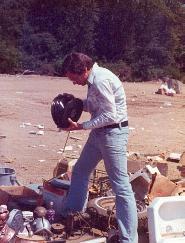
This is one of my favorite photos of hubby taken not long after we were married. It makes me laugh--but he is still going to fleamarkets and antique stores and looking through junk to find gems. He used to collect old records--truly ancient stuff. However, he gave that up and now runs around the fleamarkets looking for old accordions. Sometimes, he finds them.
This is short. It takes all of forty seconds. I went to the annual Battle of Monmouth Reenactment during the summer in the hope I would get a few good visuals specifically for this project. So I finally sat down and put it all together. The book was released in February--but, of course, it's still available AND the sequel, PATRIOT'S PRIDE, will be coming out in June 2015. I hope that's not too long for anyone to wait! :-)
You can buy the book at Amazon as well as Barnes & Noble, Kobo, etc.--or just go to the publisher's site: http://www.prismbookgroup.com
I love autumn. I love the cooler weather--so crisp and energizing. This morning it was fifty degrees outside. To me, that's wonderful! The autumn colors are gorgeous, too--red, orange, and yellow.
I just wish the leaves could stay on the trees. But no, they come down fast and furious. As soon as I remove them, more litter the ground. I don't mind so much when they're crunchy and dry, but wet, soggy leaves are horrible. They stick to shoes and wind up inside the house. This situation goes on for months. In our town, we pile the leaves at the curb for pickup. Usually, the leaves are scooped up at the beginning of December. If we have snow on top on the leaves, it gets really messy.
I bought a leaf blower that has an attachment so I can vacuum and chop up the leaves. I put the chopped up leaves into my compost bin. It makes great compost. However, I should have bought a bigger compost bin because I don't have enough room for all the leaves in our yard. :-(
I like practical gifts so for my birthday, hubby bought a six-foot long mat that should help collect the wet leaves from people's shoes when they walk in the door. I hope it works. If it doesn't, it should be useful when everyone walks in with snow on their boots this winter.
Daughter #2 looked at this photo and thought the lavender cloud in the sky looked like a UFO. To me, it looked like a cloud. I took this picture because the foggy mist settling on the ground fascinated me. I wanted to walk through it, but I was expected elsewhere and so I didn't. I've seen this phenomena a few times in the past and I've always wanted to walk through it, but I never have the time.
Driving in fog is dangerous. Walking in fog is interesting, but the fog on the ground in this photo was only about four feet high. Could I see my feet if I walked into it? What would it smell like? Would my clothing become damp from the mist? Would it swirl around me as I moved through it?
I could write up an entire scene about this low-lying fog--if I got out of my car to investigate it.
This is a photo taken in 1998. Hubby's parents had been living in Florida full-time at that point for ten years. Our daughters grew up seeing their paternal grandparents twice a year. It all started because Dziadzi and Babci decided winters were too cold in NY. They had friends who bought a house in Florida, and they moved into a house across the street from their friends.
They had fun. They grew oranges, grapefruits, and gigantic lemons. They traveled. They joined a Polish club and danced polkas every weekend.
We visited them once a year with our daughters. They visited us once a year. Eventually, hubby's father grew very ill. Babci and Dziadzi's visits to NJ ended.
Their lovely house was sold. Dziadzi died. We suggested to his mother that she ought to move near us, or near some of the other relatives in this part of the country because there are no other relatives in the south.
She refused to do so until this spring. We found a senior residence nearby and were very fortunate to secure an apartment for Babci.
We looked for inexpensive furniture. We flew to Florida and shipped many of Babci's precious possessions to NJ. We flew home and filled up the apartment. We flew back to Florida and shipped more necessities.
We emptied the apartment.
At last, we got on a plane with Babci and flew back to NJ. We settled her in her new residence. She said she likes it.
It's been a lot of work, but we feel better now that we can keep an eye on Babci. For many years, she had a nice life in Florida, but now she's starting a new adventure.
The price of a digital edition of PRINCE OF THE MIST is now $.99! This is a real steal! Read the reviews below.
Wendi, a reviewer for The Road to Romance said, "PRINCE OF THE MIST is so well written and spellbinding, my attention was grabbed from the beginning. I read the story all at once." See the entire review at http://www.roadtoromance.ca/reviews0506/reviewprincemist.htm
The grandest vehicle my brother and I put together. We even let our little sisters ride in it.
The other day, as hubby and I walked around the block we did not see a single soul. Everyone was inside, enjoying their air conditioning. Hubby and I reminisced about growing up way back before a/c and computers. People used to hang around outside in those days. And if they were inside, the windows were open so we all knew everyone else’s business anyway.
Hubby grew up in Brooklyn and I grew up on the Jersey Shore—worlds apart in some ways but there were similarities. In both Brooklyn and NJ, one of the ways kids entertained themselves was by making their own scooters. The raw materials were readily available. All that was needed was an old shoe skate (the kind that had four metal wheels which you buckled on), a piece of 2x4 lumber (which somehow always seemed to be around), and an old wooden box crate—also easy to find. With a hammer and some nails, the homemade scooter was a wonderful contraption. Everyone decorated their scooters with bottle caps that were hammered into the wood.
The scooters made lots of noise rumbling on the street. It was wonderful!
Nowadays, there seem to be no old metal shoe skates hanging around—no old wooden crates either. Kids today have nice, shiny scooters purchased in the store. The ones we made as kids were definitely cruder, but we had a great sense of accomplishment for having put our own scooters together.
Another way the kids used up their free time back in our youth, was to put together their own go-carts. At the shore, we called them buggies. Usually, we got the wheels from an old baby carriage—but any sort of wheels would do. With more scrap lumber and a rope (used for steering), we had an exceptional vehicle. Naturally, you needed either a hill or someone to push if you wanted to go anywhere.
I know I acquired some rudimentary mechanical skills from the labor—as well as a sense of pride. Where else would I have ever learned about cotter pins?
Everyone played baseball on the street. We did not have teams or coaches.
We got sweaty and dirty. But we had fun. And it didn’t cost anything.
I'm a homebody. Though I have traveled here and there over the years, I invariably get homesick during the course of any journey. Lately, leaving my elderly father causes me considerably anxiety. However, I have discovered that my cellphone offered an antidote for my malady. For me, social media has alleviated a great deal of my apprehension.
I spent time texting and posting this past week while we were in Florida preparing to relocate my mother-in-law to NJ. I called my father everyday. I chatted with Daughter #2 and #3. Daughter #1 sent photos of my father and we sent text messages back and forth. Friends responded to my posts on Facebook.
The distance between me and NJ did not feel like an impossible chasm. Though I was 1,100 miles away, I was always in touch. While there are those who abhor social media, I think it's terrific. There are many who find it refreshing to get away from technology, I know I would suffer agonizing withdrawal if I turned off my cellphone.
How about you? Can you leave everything behind without any worries? Or is your cellphone your lifeline?
The saying on this t-shirt is not accurate, though there are those who believe all residents of NJ are brash and obnoxious. Since I have lived in New Jersey all my life, I know there are an abundance of kind people with helping hands here. Yet, despite the bold statement on the shirt, it is one of my favorites. I wear it so frequently it may become a rag in the near future, which will be sad.
The shirt has a history. I bought the t-shirt five years ago at Newark Airport. It was ridiculously expensive, but I bought it anyhow. My sister was with me and she bought a blue version of the same shirt. The two of us went to the airport to pick up our sister-in-law, our brother's widow--a woman who grew up in Texas and lives in South Carolina. She had flown to NJ because my mother was dying. While we always kept in touch over the years, visits were infrequent due to distance, scheduling, and other responsibilities. The last time I had seen her was around the time our daughters were in grade school.
I was worried she wouldn't know what we looked like anymore, with our chubby middle-aged bodies and our colored hair. So I made a sign, just a simple one like the limo drivers use. Of course, it was neatly lettered because I am my mother's daughter. :-)
It turned out I didn't need the sign. The moment our sister-in-law stepped out of the gate, she saw us and recognized us. And we recognized her. The years in between didn't matter.
It was a great comfort to have her with us. We survived that sorrowful time, not because we come from NJ, but because our sister-in-law and many others were there to support us. There were friends and relatives who sat with my father through my mother's last hours while hubby and I made funeral arrangements. There were many who came to the wake and the funeral to pay their respects.
When I wear the shirt, I remember those who strengthened me by reaching out with their concern during that time. I thank them with all my heart.
Inspiration is everywhere, but for me old houses have a way of sparking story ideas. So this past week, hubby and I visited Liberty Hall Museum in Union, NJ, on the campus of Kean University. Hubby simply wanted to go on a day trip because the weather was nice, but I was hoping to feed my muse. :-)
William Livingston built Liberty Hall in 1772. Originally, it had fourteen rooms. Livingston soon became the first elected governor of New Jersey. Over the years, additions were made to the original structure. It now has fifty rooms and an extensive collection of antiques. Our tour guide claims the family never threw anything out, making it a treasure trove of artifacts.
The Livingston/Kean families were the movers and shakers of their times. They had lots of money, though they were not ostentatious about it. Nevertheless, they went on many trips and brought home an array of souvenirs. There are plenty of unusual antiques all over the house. There's a monstrous gas dryer in the basement unlike anything I've ever seen. There's a fantastic Victorian era dollhouse. There's a linoleum floor, which was originally in one of the children's rooms. The linoleum has a map of the United States on it with all the capital cities. There's a pair of three-wheeled roller skates.
Beautiful gardens surround the house. There's an orchard and a boxwood hedge. At the back of the house is an enclosed porch. For a $40 reservation, anyone can enjoy tea on a Wednesday afternoon in the enclosed porch. Weddings and other events can also be held on the grounds. And yes, there is a ghost story--of sorts. One visitor wrote about it at http://www.hiddennj.com/2011/11/was-that-ghost-i-saw-bogus-haunting-of.html. She claims the tour guides don't mention it anymore, but our tour guide did. :-) Visit Liberty Hall online HERE. Then plan your own visit. You might get some ideas for a story. :-)
That's Dad looking at my Nook. We were sitting in a doctor's office and I showed it to him. Even without his glasses, he could see the print because I made it large enough. :-)
Yesterday, I loaded my newly contracted book, PATRIOT'S PRIDE, into my Nook. I must check for errors before I send it off to the editor again. I've found that I never catch everything when I'm reading it on the computer screen. It is helpful for me to switch to another type of reading mode.
I've been fixing the story as suggested by the editor. In addition, I spellchecked the manuscript and discovered I had consistently misspelled hiccupped and unmistakable. :-(
To load the manuscript into the Nook, it is best to use an epub format. The Nook will not display anything properly in a pdf.
I downloaded Calibre (http://calibre-ebook.com) onto my Mac. Then I took out the page numbers on the docx file and saved it as an rtf. I loaded the book into Calibre and converted it to epub. Then I sent it to the Nook.
It looks good including italics and paragraph breaks.
I started reading and found I had used the instead of to in the first paragraph. Grrrr.
So I'll be doing more fixing on this manuscript--but it should be released in June. I'm sure it will go through more editing before that.
When I was cleaning out my parents house to sell it back in 2011, I found these keys in my parents' basement in an old coffee can. Obviously, my father and mother saved every key they ever owned. There were keys from cars that had long since rusted away. There were keys from houses they moved out of. I was amazed at the collection because hubby and I toss keys into the trash whenever they are no longer of any use. But my parents had enough keys to melt down and make a large ingot. Some of the keys are quite lovely. In the not-so-distant past, most tools had some sort of decoration. Today, utilitarian objects are often sleek and boring. Car keys have evolved into amazing electronic gadgets, and there are plastic cards to open hotel rooms.
I like the old keys. I kept them, in the same coffee can, but now they reside in my basement. Sometimes, I take out the can and reminisce about the cars we drove and the suitcases we carried.
Someday there won't be any keys at all.
That's me, age two, sleeping peacefully. I love to sleep like a rock. Although there have been times when traumatic events and other difficult issues have kept me awake, I learned early how to handle the problem. For me, the best thing to do when sleep eludes me is to pick up a book. In fact, I regularly read in bed before I turn out the light.

 Many year ago, hubby and I visited the Eastern State Penitentiary in Philadelphia. The prison started out as a great idea for the Quakers assumed people were inherently good. Therefore, the penitentiary was built so that those incarcerated would have time to reflect on the bad things they did and return to good behavior.


.jpg)